
Alignment determines outcomes.
Executive Summary
Despite sustained investments in education, many economies continue to face persistent skills shortages, youth unemployment, and underemployment. This disconnect is not driven by a lack of talent, but by weak alignment between education systems and labour market demand. Evidence from global labour and education data shows that systems that integrate policy, industry, and education design deliver stronger employment outcomes, higher productivity, and better returns on public and philanthropic investment.
This article applies a systems analysis lens to the education-to-workforce transition, outlines the economic and social cost of misalignment, and presents actionable, evidence-led strategies relevant to policymakers, donors, and institutional leaders.
The Scale of the Problem: What the Data Shows
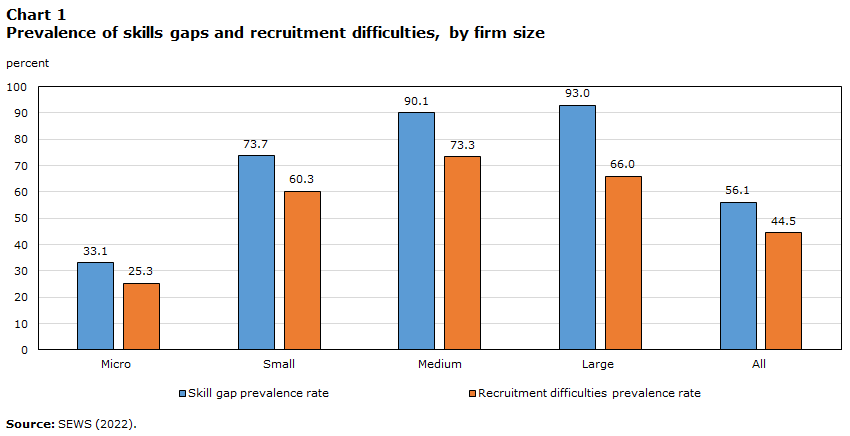
- According to the World Bank, over 40% of employers globally report difficulty filling roles due to skills gaps, even in regions with high graduate output.
- The OECD reports that countries with strong vocational education and work-based learning systems record significantly lower youth unemployment rates, in some cases up to 50% lower than systems relying predominantly on academic pathways.
These figures point to a systemic failure: education expansion without labour market integration does not automatically translate into employment or productivity gains.
A Systems View of the Education–Workforce Interface
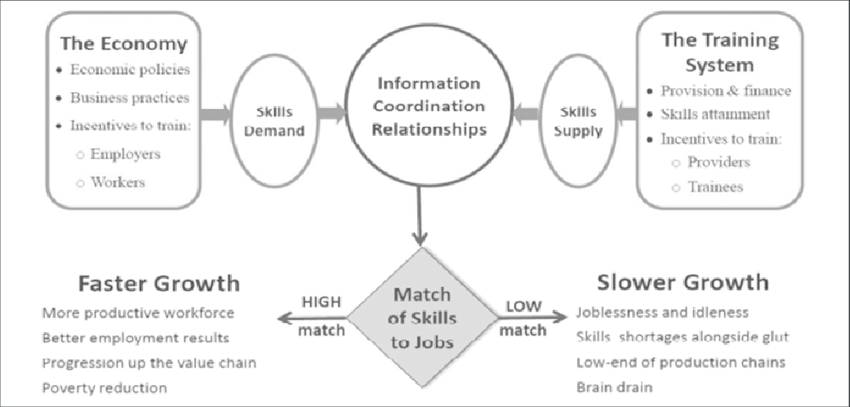
Effective education-to-work transitions depend on coordinated performance across four interdependent subsystems:
- Education and Training Institutions – responsible for skills formation and credentials.
- Labour Market and Industry Actors – defining real-time and future skills demand.
- Policy and Financing Frameworks – shaping incentives, accountability, and scale.
- Learners and Workers – navigating pathways, transitions, and lifelong learning.
Misalignment occurs when feedback loops between these subsystems are weak or delayed. In such systems, qualifications lose labour-market value, employers bear retraining costs, and learners shoulder the risk of poor outcomes.
Where Alignment Breaks Down
1. Curriculum–Labour Market Lag
Formal curricula often operate on multi-year review cycles, while labour market needs evolve continuously. In fast-moving sectors such as digital technology, renewable energy, and advanced manufacturing, this lag renders skills obsolete before graduates enter the workforce.
2. Credentials Without Competence
Traditional degrees remain dominant signals of employability, yet employers increasingly prioritise demonstrable skills. Surveys consistently show that problem-solving, digital literacy, and applied technical skills are more predictive of job performance than qualifications alone.
3. Fragmented Industry Engagement
Industry involvement is frequently advisory rather than structural. Without co-ownership of learning outcomes, education systems struggle to produce job-ready graduates at scale.
4. Weak Transition Infrastructure
Limited access to apprenticeships, internships, and structured work-based learning leaves learners unprepared for workplace realities and slows school-to-work transitions.
Why Alignment Is a Policy and Donor Priority
From a policy and investment perspective, alignment delivers measurable returns:
- Improved employment outcomes and reduced youth unemployment
- Higher productivity and competitiveness for local industries
- Lower public expenditure on remedial training and unemployment support
- Greater equity, as transparent pathways reduce reliance on informal networks
In contrast, misaligned systems externalise costs to households, employers, and governments, undermining the long-term impact of education spending.
Evidence from Practice: What Works

Case Illustration 1: Dual Training Systems
Countries that integrate classroom learning with paid workplace training have demonstrated consistently stronger outcomes. In Switzerland, about 70% of young people participate in vocational education and training (VET), which is the primary path at the upper-secondary level. Germany’s dual system is the most popular education route, with over 50% of college-bound students also seeking vocational training. OECD research indicates that countries such as Germany and Switzerland, which heavily use dual VET models in which students spend significant time in the workplace, tend to have smoother transitions from school to work and lower youth unemployment rates. For more details, visit OECD.
Case Illustration 2: Industry-Led Curriculum Reform
In Singapore’s SkillsFuture system, structured collaboration between government, industry, and training providers enables rapid curriculum updates aligned with priority growth sectors. As a result, over 90% of graduates from applied and technical education pathways secure employment within six months of graduation.
Case Illustration 3: Modular and Stackable Credentials
Education systems adopting micro-credentials and modular certification allow workers to upskill rapidly in response to labour market shifts. According to the OECD’s work on micro-credentials these approaches improve employability outcomes and strengthen employer confidence in skills signalling.
Closing the Gap: A Systems-Aligned Strategy
1. Institutionalised Co-Design
Policy frameworks should mandate sustained collaboration between education providers and industry, moving beyond consultation to joint ownership of learning outcomes.
2. Embedded Work-Based Learning
Apprenticeships, cooperative education, and industry projects should be core programme requirements, supported by public and donor financing.
3. Adaptive Curriculum Governance
Regulatory systems must enable faster curriculum updates informed by labour market data and employer feedback.
4. Competency-Based Assessment
Assessment models should prioritise applied skills alongside theory, supported by recognised alternative and modular credentials.
5. Data-Driven Feedback Loops
Graduate employment outcomes, employer satisfaction, and skills demand data should directly inform funding, accreditation, and programme design decisions.
Implications for Policymakers and Donors
For policymakers, the priority is enabling coordination across ministries, regulators, and industry. For donors and development partners, the highest impact investments are those that strengthen system linkages rather than isolated programmes.
Strategic funding that supports curriculum co-design, work-based learning infrastructure, and data systems delivers more durable outcomes than short-term skills interventions.
From Pipelines to Talent Ecosystems
The future of work demands continuous learning, mobility, and adaptability. Education systems must evolve from linear pipelines into dynamic talent ecosystems where learning and work reinforce each other throughout the life course.
Conclusion
The education–workforce gap is not inevitable. It is a design challenge rooted in misaligned systems. Evidence shows that when education, labour markets, and policy frameworks are intentionally aligned, outcomes improve for learners, employers, and society.
For policymakers and donors seeking sustainable impact, the message is clear: alignment is not optional—it is the determinant of outcomes.